14 Brilliant Kids’ Room Organization Ideas That Will Save Your Sanity
A kids’ room can go from perfectly tidy to toys-everywhere chaos surprisingly fast. Books land on the floor, art supplies migrate to the desk, stuffed animals take over the bed, and somehow there is never enough space for everything.
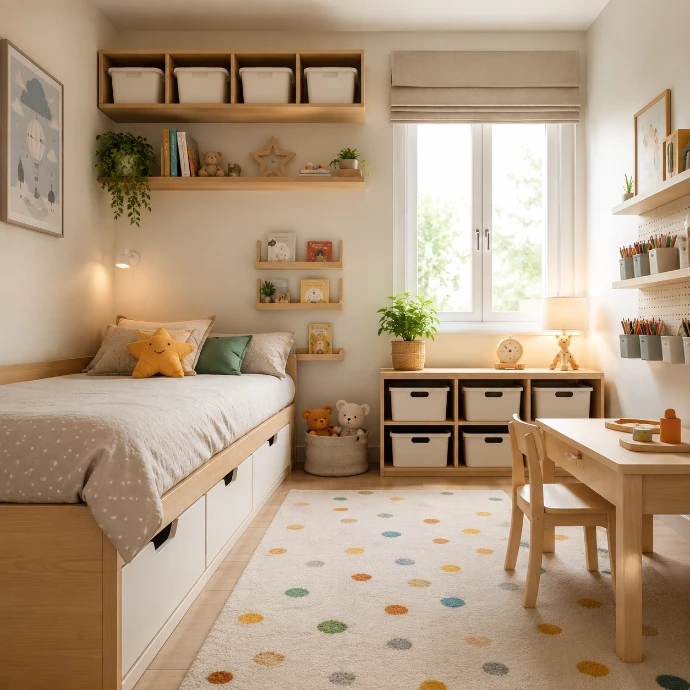
Good kids’ room organization is not about creating a picture-perfect bedroom that children are afraid to touch. It is about building a room where toys, clothes, books, school supplies, and everyday essentials have simple places to go.
More importantly, the organization system should be easy enough for your child to use without needing help every time.
Whether you are organizing a small bedroom, shared kids’ room, toddler space, or school-age child’s bedroom, the following practical ideas can help you create a room that feels calmer, functions better, and is much easier to maintain.
Tips for Crafting a Brilliant Kids’ Room Organization
Before buying another basket or storage unit, look carefully at what actually creates clutter in the room.
Is the floor covered with toys? Are books constantly piled beside the bed? Does your child have nowhere to put school supplies? Are clothes difficult to reach or put away?
Start by sorting belongings into simple categories such as:
- Everyday toys
- Books
- Clothes and shoes
- Art and craft supplies
- School supplies
- Stuffed animals
- Building blocks and puzzles
- Keepsakes
- Items your child has outgrown
Once you know what needs to be stored, you can choose storage based on the items rather than filling the room with random containers.
Keep frequently used belongings within your child’s reach. Less-used items can go on higher shelves or inside upper cabinets.
It also helps to leave some storage space empty. A shelf packed from edge to edge becomes difficult to maintain, while a little breathing room makes putting things away much easier.
For younger children, simple picture labels can work better than written labels. Older children can use categories such as School, Art, Games, and Books.
The best system is usually the one that requires the fewest steps.
1. Maximize Vertical Space with a Built-In Study Station

When floor space is limited, walls become extremely valuable.
A built-in study station can combine a desk, shelving, drawers, and cabinets within one compact section of the bedroom. Instead of adding a separate desk, bookcase, and storage cabinet, you can create one organized homework zone.
For example, a small wall could include:
Desk surface + two drawers + overhead shelves + side cabinet + task light
Keep school supplies in the lower drawers and books on shelves directly above the desk. Less frequently used supplies can be stored higher up.
A pegboard or small pinboard above the desk can hold schedules, notes, artwork, and lightweight stationery.
When planning the desk, remember that children grow. A design that works beautifully for a six-year-old may become uncomfortable several years later. If possible, choose an adjustable chair and a desk height that can remain useful as your child gets older.
Good task lighting matters too. Position the desk near natural light when practical, then add a dedicated desk lamp for homework after sunset.
The result is a defined work area without sacrificing a large portion of the bedroom.
2. Use Open Storage with Labeled Bins for Toys and Books

Children are more likely to put something away when they immediately know where it belongs.
That is why open cubbies paired with labeled bins can be particularly effective for kids’ room organization.
Instead of one enormous toy box containing everything, divide toys into broad categories.
For example:
- Blocks
- Cars
- Dolls
- Animals
- Puzzles
- Art supplies
- Dress-up accessories
Avoid creating too many tiny categories. If cleaning the room requires deciding between ten different toy bins, the system becomes unnecessarily complicated.
Books can occupy one or two open cubbies while toys stay inside removable bins.
For toddlers and preschoolers who cannot read yet, add a small picture to each container. A toy car image on the vehicle basket makes its purpose immediately understandable.
Choose lightweight bins with smooth edges for storage that children will handle themselves. Heavy containers and breakable baskets are better reserved for areas adults manage.
One useful rule is simple: the easier storage is to understand, the easier it is to maintain.
3. Design Around the Bed for Built-In Functionality

The bed takes up a considerable amount of floor space, so make it work harder.
Storage drawers underneath the bed can hold spare bedding, seasonal clothing, toys, shoes, or larger items that are difficult to fit elsewhere.
Built-in cabinetry around the bed can provide even more storage.
A practical arrangement might include two narrow wardrobes or cabinets on either side of the bed with upper cupboards connecting them. Small bedside niches can replace traditional nightstands.
This approach is especially useful for small kids’ bedroom organization because it uses an area that would otherwise have a single purpose.
However, avoid making the sleeping area feel boxed in. Use lighter finishes and leave some visual space around the bed.
Safety also needs to guide the design. Cabinets and shelving should be properly secured, and heavy objects should not be stored loosely on shelves directly above where a child sleeps.
If built-ins are outside your budget, under-bed boxes can provide a simpler alternative.
Measure the available height before purchasing containers and choose bins that slide out easily. Transparent containers or clearly labeled boxes will prevent the space beneath the bed from becoming forgotten storage.
4. Create a Grab-and-Go Station for Daily Essentials

School mornings become easier when frequently used items are stored together.
Create a small grab-and-go station near the bedroom door or another convenient location.
Depending on your child’s age and routine, it could hold:
- Backpack
- School shoes
- Jacket
- Hat
- Hair accessories
- Sports bag
- Water bottle
- Next-day outfit
Wall hooks are particularly useful because children can hang backpacks and jackets without opening wardrobes or using hangers.
Install hooks at a height your child can comfortably reach.
A small basket underneath can hold shoes, while a narrow shelf can provide space for smaller items.
You can also introduce a simple evening routine: before bedtime, prepare tomorrow’s outfit and place everything needed for school in the station.
It may only save a few minutes each morning, but those minutes can make the routine feel considerably calmer.
5. Incorporate Built-In Cabinets for Seamless Storage

Some children have plenty of belongings but very little visual tolerance for clutter. In this situation, closed cabinets are extremely useful.
Built-in cabinetry provides designated storage while keeping the room visually calm.
Use cabinets for things such as:
- Board games
- Extra bedding
- Seasonal clothing
- Large toy collections
- Craft supplies
- Keepsakes
- Sports equipment
You do not necessarily need floor-to-ceiling custom cabinetry.
A row of lower cabinets beneath a window, for example, can provide storage while also creating a window seat. A tall cabinet beside a desk can serve as both school storage and a compact wardrobe.
Inside the cabinets, continue using categories. Otherwise, closed storage can quickly become clutter hidden behind doors.
Small baskets, drawer dividers, and shelf organizers can keep everything separated.
For younger children, secure tall furniture appropriately and keep potentially unsafe objects in adult-controlled storage.
Choosing cabinet finishes similar to the walls can also help large storage units visually blend into the bedroom rather than dominate it.
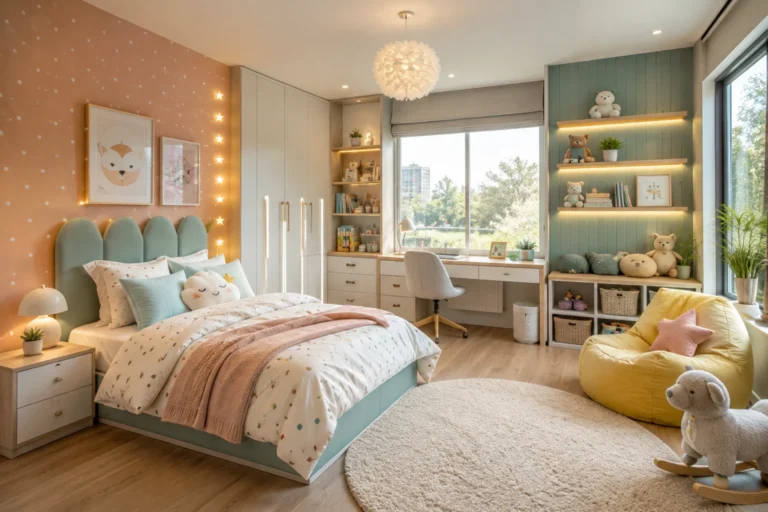
6. Make Organization Fun with a Rainbow-Themed Room

Organization does not need to look serious.
Color can actually become part of the storage system.
A rainbow-inspired bedroom might use muted red, peach, yellow, sage, dusty blue, and lavender across storage bins, shelves, or small decorative details.
Rather than filling every surface with bright colors, keep the foundation relatively neutral and use color strategically.
You could assign categories by color:
| Color | Storage Category |
|---|---|
| Red/Pink | Dolls and figures |
| Yellow | Building toys |
| Green | Art supplies |
| Blue | School supplies |
| Purple | Dress-up accessories |
This approach adds personality while helping children recognize where belongings should go.
If a full rainbow palette feels too busy, choose three or four complementary colors instead.
Muted tones work particularly well because they create a playful bedroom without overwhelming the space.
The important part is consistency. Once blue represents school supplies, for example, keep that category recognizable throughout the storage system.
7. Create a Minimalist Homeschool Nook

If your child studies at home regularly, a dedicated learning area can prevent school supplies from spreading across the entire bedroom.
You do not need a huge desk.
A compact desk against a quiet wall can be enough when paired with thoughtful storage.
Keep only everyday essentials on the desktop:
- Pencil cup
- Notebook
- Current schoolbooks
- Desk lamp
- Small organizer
Everything else can stay inside drawers, cabinets, or labeled containers.
A floating shelf above the desk can hold reference books and a few decorative pieces. A corkboard or magnetic board can display schedules and important reminders without covering the desk itself.
Consider separating school supplies from play supplies whenever possible.
When crayons used for homework are mixed with dozens of craft materials, finding what is needed becomes harder. A dedicated school drawer can solve that problem.
A visually calm learning area may also make it easier for children to understand when the space is being used for focused work.
8. Add Floating Shelves for Flexible Display and Storage

Floating shelves are useful when you need storage but do not want another piece of furniture taking up valuable floor space.
They work well for:
- Books
- Framed artwork
- Small baskets
- Collectibles
- Lightweight toys
- Decorative objects
One or two well-positioned shelves are often more useful than covering an entire wall.
Place frequently used items at accessible heights and reserve higher shelves for decorative or adult-managed belongings.
You can also install floating shelves above a desk or low storage unit to create a vertical organization zone.
Try mixing functional and decorative objects rather than filling every shelf with decor.
For example, one shelf could hold several favorite books, a small framed picture, and one lightweight decorative item.
Remember that shelves need secure installation. Use suitable fixings for the wall type and avoid placing heavy or breakable objects where they could fall onto a bed, desk, or play area.
9. Use Color-Coded Drawers for Craft and School Supplies

Craft supplies have a special ability to spread everywhere.
Markers end up under beds, paper gets mixed with homework, and tiny craft pieces seem to appear in every corner.
A drawer system can keep these supplies contained.
Give each drawer a broad category such as:
- Paper
- Coloring
- Painting
- Cutting and gluing
- School supplies
- Craft materials
You can then use different drawer labels or colors to make each category easy to recognize.
Avoid making the categories overly specific. A child is much more likely to return all coloring materials to one drawer than separate crayons, pencils, markers, and chalk into individual containers after every activity.
Small internal trays are still useful for preventing tiny supplies from mixing together.
For younger children, keep scissors, glue, paints, and other materials appropriate to their age and level of supervision.
A rolling drawer cart can also work well if the bedroom doubles as a homework and creative space. It can stay beside the desk during projects and move away afterward.
10. Design a Tween-Friendly Space with Grown-Up Style

Organization requirements change as children grow.
A tween may no longer need several large toy boxes but could need more storage for books, clothes, hobbies, electronics, school materials, and personal belongings.
This is a good time to update the bedroom without making it feel overly adult.
Start with flexible furniture in relatively timeless finishes such as white, warm wood, soft gray, beige, or muted colors.
Then introduce personality through items that are easier to replace:
- Bedding
- Posters
- Artwork
- Cushions
- Desk accessories
- Storage boxes
Provide enough closed storage to prevent everyday belongings from dominating the room.
A bedside drawer can hold chargers and small electronics. Desk drawers can contain stationery, while a wardrobe organizer can provide separate sections for clothes and accessories.
Give your tween some control over the system.
Ask: Where would you naturally put this after using it?
Their answer may be more useful than creating an organization system based solely on how you think the room should function.
11. Use Clear Bins and Labels for Categorized Toy Storage

Clear containers solve one common storage problem: forgetting what is inside.
They can work particularly well inside closets, cabinets, and larger shelving units.
Instead of opening several boxes to find building blocks, children can see the contents immediately.
Labels make the system even clearer.
Use broad categories such as:
LEGO | CARS | PUZZLES | DOLLS | ANIMALS | CRAFTS
For younger children, combine words with pictures.
However, clear bins do not need to be displayed everywhere. A wall filled with transparent containers can look visually busy because every toy remains visible.
Consider using clear bins inside closed cabinets and more decorative baskets in open areas.
Also pay attention to weight.
A huge container filled with building blocks may become too heavy for a young child to move safely. Several medium-size bins can be more practical than one oversized container.
Periodically review each category and remove broken, unused, or outgrown toys. Storage becomes much easier when containers are not overflowing.
12. Soft Storage and Low Furniture for Toddler-Friendly Organization

A toddler’s room should be organized differently from an older child’s bedroom.
Accessibility and safety are the priorities.
Use low storage units so your toddler can reach everyday books and toys without climbing.
Soft fabric bins can be helpful for lightweight items such as:
- Stuffed animals
- Dress-up clothes
- Soft toys
- Blankets
- Large building pieces
A low book rack with covers facing outward makes books easier for young children to recognize.
You can also create a simple cleanup routine with only a few categories. For example:
Books go here. Soft toys go here. Blocks go here.
That is often enough.
Too many categories make independent cleanup unnecessarily complicated.
Furniture stability is particularly important in toddler rooms. Follow manufacturer anchoring instructions for furniture that presents a tip-over risk, and avoid placing climbable furniture in unsafe positions.
Keep small objects and items requiring adult supervision outside the child’s independent storage area.
The goal is to make safe choices easy and intuitive.
13. Mix Closed and Open Storage for Balanced Design

An organized room does not need everything hidden.
In fact, combining open and closed storage often provides the best balance between accessibility and visual calm.
Use open storage for belongings your child reaches for frequently:
- Favorite books
- Everyday toys
- School supplies
- A few display pieces
Use closed storage for visually busy or less frequently used items:
- Extra toys
- Seasonal clothing
- Spare bedding
- Large collections
- Craft materials
- Keepsakes
Imagine a wall with lower cabinets, several open cubbies, and two floating shelves.
The cabinets hide clutter. The cubbies keep everyday items accessible. The shelves provide space for books, artwork, or a few personal objects.
This layered approach prevents the bedroom from looking either completely bare or overwhelmingly full.
Another useful guideline is to avoid filling every available surface.
Empty space is not wasted space. It gives the room room to function and makes future cleanup easier.
14. Designate a Creative Corner with Wall Art Display

Children create a surprising amount of artwork, and without a designated place for it, drawings quickly accumulate on desks, dressers, and floors.
Turn one small part of the bedroom into a creative corner.
Start with a child-size or standard desk depending on age. Add accessible storage for paper, pencils, crayons, and other appropriate supplies.
Then use the wall above the workspace to display finished creations.
Possible display solutions include:
- Clip rails
- Corkboards
- Magnetic boards
- Simple frames
- Hanging wire with clips
- A rotating gallery wall
A rotating display is particularly practical.
Instead of trying to display every drawing forever, let your child choose several favorites. When new artwork is created, replace older pieces and save only the most meaningful ones.
You can create a slim portfolio box for special artwork that your child wants to keep.
This approach gives creativity a clear home while reducing paper clutter throughout the bedroom.
Keep the workspace itself relatively simple. A small organizer for everyday supplies and separate storage for larger craft materials is usually enough.
Most importantly, design the corner around how your child actually creates.
If they love drawing, prioritize paper and pencil storage. If they build models, provide a larger work surface and containers for small pieces.
Kids’ room organization works best when the room supports the child’s real habits instead of forcing them into a system that looks good but is difficult to use.
A Tidy Room Is a Happy Room
A well-organized kids’ bedroom does not have to remain spotless all day. Children need room to play, create, study, read, and simply be children.
The real goal is to make resetting the room manageable.
Start with the biggest clutter problem rather than attempting to reorganize everything in one weekend. If toys are taking over the floor, begin with toy storage. If school supplies are the problem, establish a study station first.
Then build the rest of your kids’ room organization system gradually.
Keep frequently used belongings within reach, combine open and closed storage, use clear categories, take advantage of vertical space, and choose solutions that can adapt as your child grows.
Most importantly, involve your child. Ask which toys they use most, where they prefer to keep books, and what makes cleanup difficult.
A beautiful storage system is helpful, but a simple system your child can actually maintain is far more valuable.
Conclusion
Effective kids’ room organization is less about adding more storage and more about giving everything a practical home.
A few thoughtful changes—such as labeled bins, under-bed drawers, floating shelves, low toddler storage, a dedicated homework station, or a small creative corner—can completely change how the bedroom functions.
You do not need to implement all 14 ideas at once. Choose one problem area, create a simple solution, and see how your child responds. Once that system becomes part of the daily routine, move to the next area.
The best kids’ room is not the one that looks perfectly styled every minute. It is the one where your child can easily find what they need, enjoy their space, and know where things belong when playtime is over.