Stunning Mosaic Kitchen Backsplash Ideas for a Modern Makeover
A kitchen backsplash may cover only a small portion of the room, but visually, it can change almost everything.
The right mosaic can bring color to plain cabinetry, add texture to a neutral kitchen, or turn the wall behind your range into a feature that immediately catches the eye. Better still, mosaic tiles come in enough materials, shapes, colors, and patterns to work with everything from sleek contemporary kitchens to relaxed rustic spaces.
These mosaic kitchen backsplash ideas show how glass, natural stone, metallic finishes, geometric shapes, and artistic patterns can give your kitchen a more polished personality without requiring a complete renovation.
Whether you prefer a quiet monochromatic scheme or a backsplash filled with pattern and character, the key is choosing a mosaic that complements the permanent elements already in your kitchen.
The Power of Mosaic Kitchen Backsplash Ideas in Your Home
Mosaic backsplashes are especially useful because they combine a practical wall surface with decorative detail.
Unlike a large-format tile that creates broad uninterrupted areas, mosaic tiles are made from smaller individual pieces. Those pieces introduce additional grout lines, pattern, movement, and texture. Depending on the design, the effect can be subtle or highly decorative.
Mosaics are available in materials such as:
- Glass
- Marble
- Travertine
- Ceramic
- Porcelain
- Metal
- Mixed stone
- Mother-of-pearl and other specialty materials
The scale of the mosaic matters as much as its color. Tiny pieces tend to create a busier, more intricate surface, while larger mosaic shapes can look cleaner and more architectural.
Before making a final choice, look at your cabinets, countertops, flooring, hardware, and natural light together. A backsplash should connect these elements rather than compete with every one of them.
It is also worth ordering samples. Tile colors and reflective surfaces can look very different under kitchen lighting than they do on a computer screen.
1. Imagine a Geometric Glass Mosaic for Modern Homes
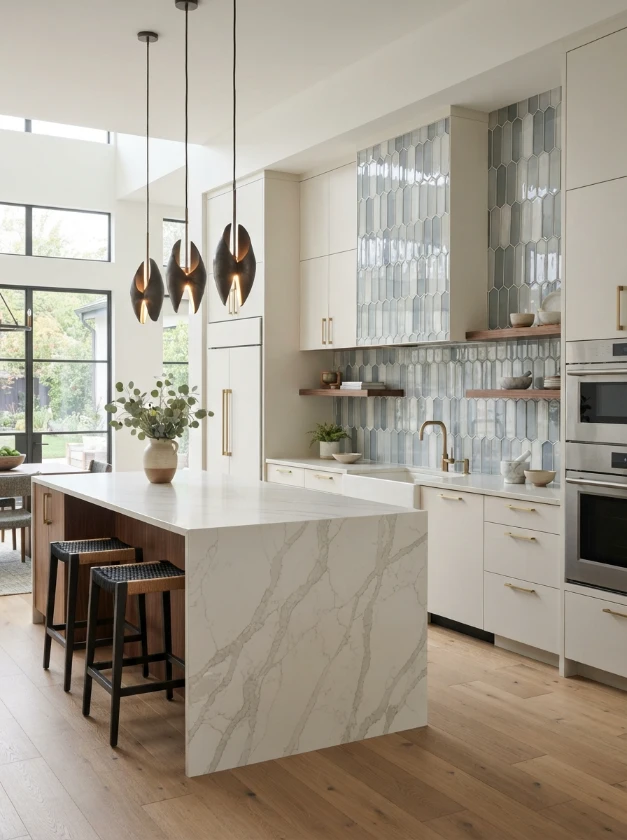
Geometric glass mosaics are an excellent way to introduce contemporary detail without making a kitchen feel overly decorated.
Instead of traditional square mosaics, consider hexagons, elongated diamonds, triangles, cubes, or other angular forms. Their repeated geometry creates visual movement, while glass adds a clean reflective quality.
For a bright modern kitchen, a pale blue-gray or soft white glass mosaic can work beautifully with white cabinets and light quartz countertops.
Want something more dramatic?
Try charcoal, smoky gray, navy, or muted green glass against warm wood cabinetry. The contrast between reflective glass and natural timber can make both materials look more distinctive.
Glass is particularly effective in kitchens that receive limited natural light because its surface can reflect surrounding illumination. However, highly reflective tile can also emphasize strong under-cabinet lighting, so view your sample in both daytime and evening conditions.
Design tip: If the tile already has an intricate geometric shape, consider grout in a similar tone. High-contrast grout will emphasize every individual piece and can make an already detailed backsplash look considerably busier.
2. Picture a Natural Stone Mosaic for Rustic Charm
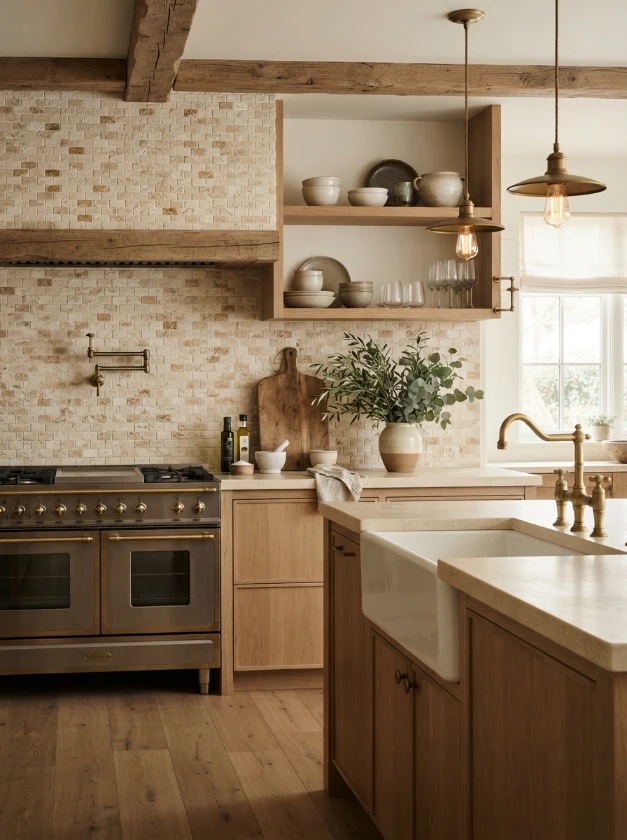
Natural stone brings warmth and irregularity that manufactured surfaces sometimes lack.
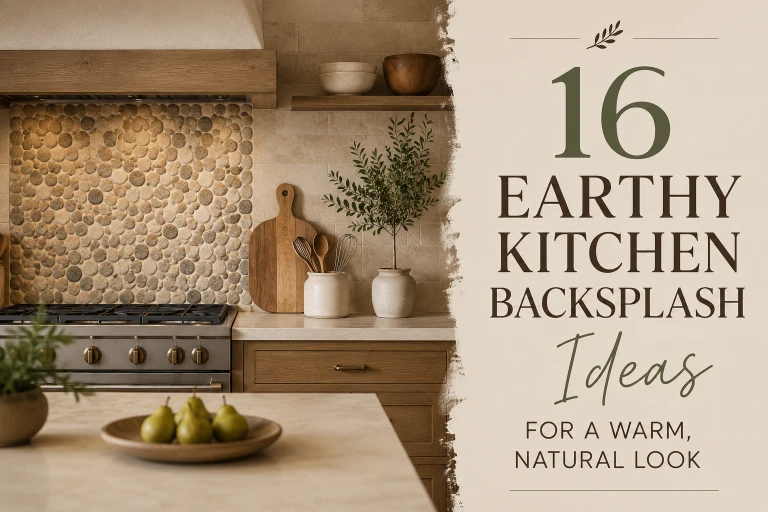
Marble, limestone, slate, and travertine mosaics contain variations in tone, veining, and texture. These small differences are exactly what can make a stone backsplash feel authentic and inviting.
A creamy travertine mosaic, for example, can soften a kitchen with warm oak cabinetry, off-white countertops, and aged brass hardware.
For a moodier rustic kitchen, consider slate or darker stone alongside walnut cabinets, iron hardware, and warm pendant lighting.
You do not necessarily need to create a traditional farmhouse kitchen to use natural stone. A simple stone mosaic can also provide welcome texture in a modern kitchen filled with flat cabinetry and smooth countertops.
Keep the surrounding palette restrained when the stone contains noticeable variation. Too many competing patterns can make the room visually heavy.
Natural stone also requires more attention to maintenance than many ceramic or porcelain alternatives. Some stones are porous and may require appropriate sealing and careful cleaning.
Practical tip: Before purchasing, ask your tile supplier about sealing requirements, stain resistance, cleaning products, and maintenance for the exact stone you are considering.
3. Try a Subway Tile Twist for Classic Appeal

Subway tile has remained popular partly because its simple proportions adapt easily to different kitchen styles.
But a subway-inspired backsplash does not have to mean rows of plain white rectangular tiles.
Smaller mosaic subway tiles can create a more detailed version of the familiar look. You can also experiment with vertical stacking, herringbone arrangements, offset patterns, or elongated rectangles.
For a timeless kitchen, try creamy white mosaic subway tiles with warm-white cabinetry, pale stone counters, and brushed brass hardware.
For something more contemporary, consider sage green, muted blue, charcoal, or glossy taupe.
Texture can make an equally important difference. Handmade-look ceramic surfaces, softly irregular edges, or subtle tonal variations give a simple rectangular shape more personality.
Would you prefer your backsplash to blend quietly into the room or become a noticeable feature?
Your grout choice can help determine the answer. A close color match creates a calmer surface, while darker contrasting grout emphasizes the pattern.
Design tip: Carrying the same tile from the countertop to the bottom of the upper cabinets usually creates a cleaner appearance than stopping it at an arbitrary height.
4. Consider a Metallic Accent Mosaic for Glamorous Style
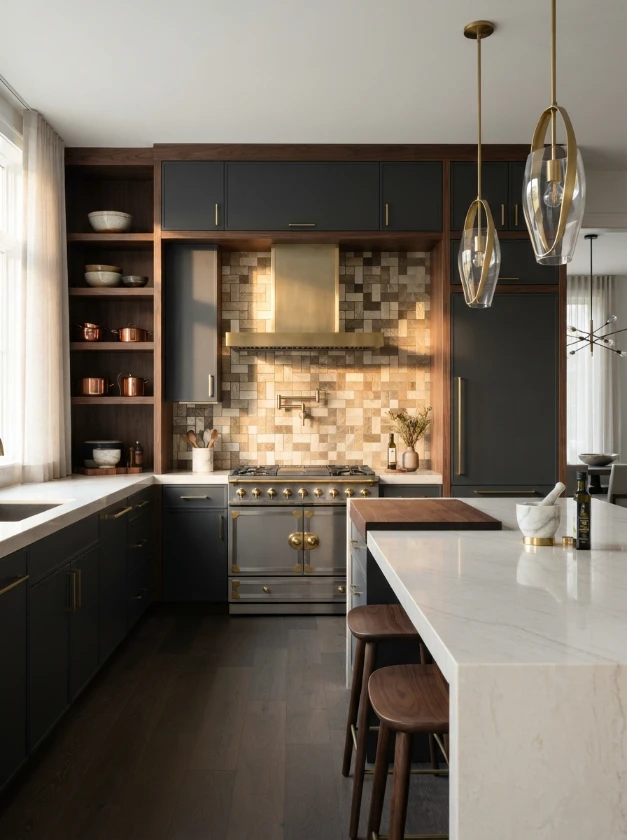
Metallic details can make a backsplash feel more sophisticated, especially when used with restraint.
Brushed brass, bronze, copper, stainless-steel tones, or mixed metallic accents can catch light and add dimension to a kitchen that otherwise relies on neutral materials.
You do not necessarily need an entire wall of metallic tile.
A narrow mosaic feature behind the cooktop, a metallic border, or a stone-and-metal mixed mosaic may provide enough visual impact without overwhelming the space.
Imagine matte black cabinets with pale quartz countertops and a restrained brushed-brass mosaic behind the range. Repeating the brass tone through cabinet handles or pendant lights can help the backsplash feel intentional.
Metallic finishes can also look striking beside walnut or other dark woods, where the warmth of the timber balances the reflective surface.
For a softer scheme, combine champagne-toned metallic pieces with cream cabinetry and warm-veined stone counters.
Avoid mixing too many unrelated metal finishes in one small area. If your backsplash has a strong brass tone, for example, repeating that family of color in one or two other details can create greater visual consistency.
Practical tip: Check the manufacturer’s care instructions before installing metallic tiles near a cooking zone. Finishes vary, and some surfaces may require specific cleaning methods to prevent scratching or discoloration.
5. Anchor a Moroccan Fish Scale Pattern for Boho Vibes
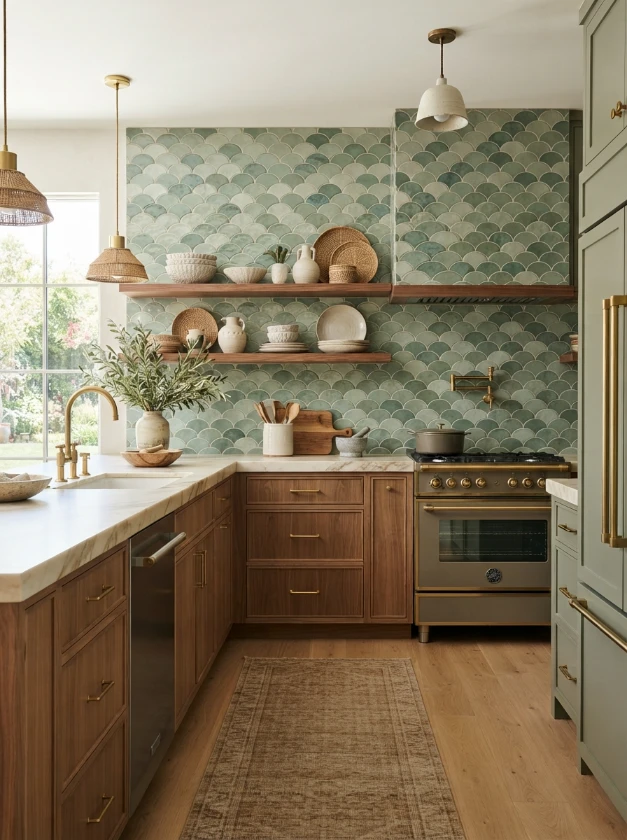
Fish scale tiles, sometimes called scallop or fan tiles, bring curves into a room usually dominated by straight cabinet lines and rectangular appliances.
That contrast is one reason the pattern can be so visually effective.
For a relaxed bohemian kitchen, consider handmade-look fish scale mosaics in teal, sea green, dusty blue, sage, or warm terracotta tones.
Pair them with natural wood cabinetry, open shelving, woven accessories, ceramic pottery, and warm metal accents. The result can feel expressive without becoming chaotic if the rest of the kitchen remains relatively simple.
You can also take the pattern in a more refined direction.
Ivory or soft beige fish scale mosaics paired with walnut cabinetry and creamy countertops create a sophisticated interpretation of the shape. Instead of relying on strong color, the curves provide the visual interest.
Installation orientation changes the effect as well. Depending on the tile, scallops can face upward or downward, producing noticeably different visual rhythms.
Because the shape itself is decorative, avoid surrounding it with too many competing patterns.
Design tip: Place a full sample sheet against your cabinets rather than judging one individual tile. Mosaic patterns become much easier to evaluate when you can see how the repeated shape behaves across a larger surface.
6. Layer a Monochromatic Mosaic for Minimalist Spaces

Minimalism does not require completely flat or featureless surfaces.
In fact, a monochromatic mosaic can be an effective way to add texture while maintaining a calm color palette.
Choose several closely related shades rather than strong contrasting colors. Warm white, ivory, cream, greige, soft gray, or muted beige can all work well.
Imagine a modern kitchen with flat-panel white oak cabinets, creamy quartz countertops, and a backsplash composed of small ivory tiles with slight tonal variations.
From a distance, the wall feels quiet and cohesive. Up close, the individual pieces and grout lines provide depth.
Finish is particularly important in a monochromatic scheme.
Mixing glossy and matte pieces can produce gentle changes as light moves across the wall. Alternatively, an entirely matte mosaic can support an organic, understated interior.
You can apply the same principle to darker kitchens. Charcoal mosaics with black or dark gray cabinetry can create a dramatic but controlled backdrop, especially when balanced with warm wood and sufficient lighting.
The secret is restraint.
Let texture, shape, and finish create interest instead of adding unnecessary colors.
Design tip: Compare your backsplash sample directly with your countertop. Two materials described as “white” can have completely different undertones, such as cool blue, warm yellow, pink, or gray.
7. Build a Patchwork Mosaic for Eclectic Kitchens

If you enjoy kitchens with personality, a patchwork mosaic offers far more freedom than a uniform backsplash.
Patchwork designs combine different motifs, colors, or tile patterns into one composition. Depending on the palette, they can reference Mediterranean interiors, vintage kitchens, traditional encaustic designs, or contemporary eclectic spaces.
The challenge is creating variety without visual disorder.
One of the easiest approaches is to establish a limited color palette first. For example:
Navy + white + muted blue + warm gray
You can then vary the motifs while allowing those repeated colors to hold the design together.
For a warmer kitchen, try terracotta, cream, olive, and muted ochre alongside natural wood cabinetry.
A patchwork backsplash works particularly well when the surrounding cabinets and countertops are relatively simple. Flat-front cabinetry, plain stone counters, and understated hardware provide visual breathing room around the pattern.
If covering an entire backsplash seems too bold, use patchwork tile as a defined feature behind the range and select a quieter coordinating tile for the remaining walls.
This gives the decorative mosaic a clear focal point.
Before installation, lay several sheets or individual tiles on a flat surface. Rearranging them before they reach the wall helps prevent similar patterns or colors from accidentally clustering together.
Practical tip: Photograph your proposed tile arrangement before installation. The photo gives you and your installer a useful visual reference for maintaining the planned distribution.
Frequently Asked Questions
Are mosaic tiles suitable for kitchen backsplashes?
Yes. Many mosaic tiles are well suited to kitchen backsplash applications, but suitability depends on the specific material and finish.
Ceramic, porcelain, glass, stone, and certain metal mosaics are commonly used. Always check the manufacturer’s recommendations, particularly when installing tile behind a cooktop or in an area exposed to grease, moisture, and frequent cleaning.
What mosaic backsplash is easiest to maintain?
Glazed ceramic, porcelain, and many glass mosaics can be relatively easy to wipe clean because their surfaces have low porosity.
However, mosaic installations contain numerous grout joints, and those joints also need maintenance.
Natural stone may require additional care or sealing depending on the material. Always follow the tile and grout manufacturer’s instructions rather than assuming every mosaic requires the same treatment.
Should a backsplash be lighter or darker than the countertops?
There is no universal rule.
A lighter backsplash can create an airy appearance, while a darker backsplash can add contrast and make the wall a stronger feature.
Instead of focusing only on light versus dark, consider undertones. The backsplash, countertop, cabinetry, flooring, and hardware should look intentional when viewed together.
Do small mosaic tiles make a kitchen look busy?
They can, particularly when the mosaic combines small pieces, contrasting grout, several colors, and an intricate pattern.
If you have a small kitchen and want a calmer appearance, choose a limited palette and grout that is close to the tile color.
You can also restrict a highly decorative mosaic to one focal area instead of using it across every available wall.
What grout color works best with mosaic tile?
It depends on how strongly you want to emphasize the pattern.
Matching or closely coordinated grout tends to create a more continuous surface. Contrasting grout outlines individual pieces and makes the geometry more prominent.
Test both options with a sample if possible because grout color can noticeably change the final appearance of a mosaic.
How do I choose a mosaic backsplash that will not quickly feel dated?
Start with the permanent features of your kitchen rather than selecting a backsplash based solely on a current trend.
Natural materials, restrained color palettes, classic geometric forms, and finishes that coordinate with your cabinetry and countertops are often easier to live with over time.
If you love a particularly bold trend, consider using it in a smaller feature zone where it provides personality without dominating the entire kitchen.
Conclusion
The best mosaic kitchen backsplash ideas do more than fill the wall between your countertops and cabinets. They help establish the kitchen’s color, texture, and overall character.
A geometric glass mosaic can sharpen a contemporary kitchen, while natural stone brings warmth and organic variation. Subway mosaics offer a familiar look with room for creative layouts, metallic accents provide controlled glamour, and fish scale patterns introduce graceful curves. For quieter interiors, monochromatic mosaics rely on texture rather than strong color, while patchwork designs can turn the backsplash into a genuine focal point.
Before committing to a design, bring samples into your kitchen and view them beside your cabinets, countertops, hardware, and flooring. Check them during both daylight and evening lighting.
A backsplash may seem like one design decision, but when its material, color, scale, grout, and surrounding finishes work together, it can make the entire kitchen feel far more considered.