Smart Small Kitchen Shelf Ideas to Maximize Space & Style
A small kitchen can start feeling crowded long before you actually run out of storage. A few mugs on the counter, cooking oils beside the stove, and an appliance or two can quickly take over the limited workspace you have.
The good news is that you don’t always need another cabinet. Smart small kitchen shelf ideas can turn overlooked wall space, awkward corners, and areas above counters into practical storage while adding character to the room.
The key is deciding what deserves to be displayed, what should remain hidden, and where each shelf will make everyday kitchen tasks easier. Below are practical shelving ideas that combine storage, organization, and style without making a compact kitchen feel overloaded.
1. Keep Countertops Clear With Smart Kitchen Shelves
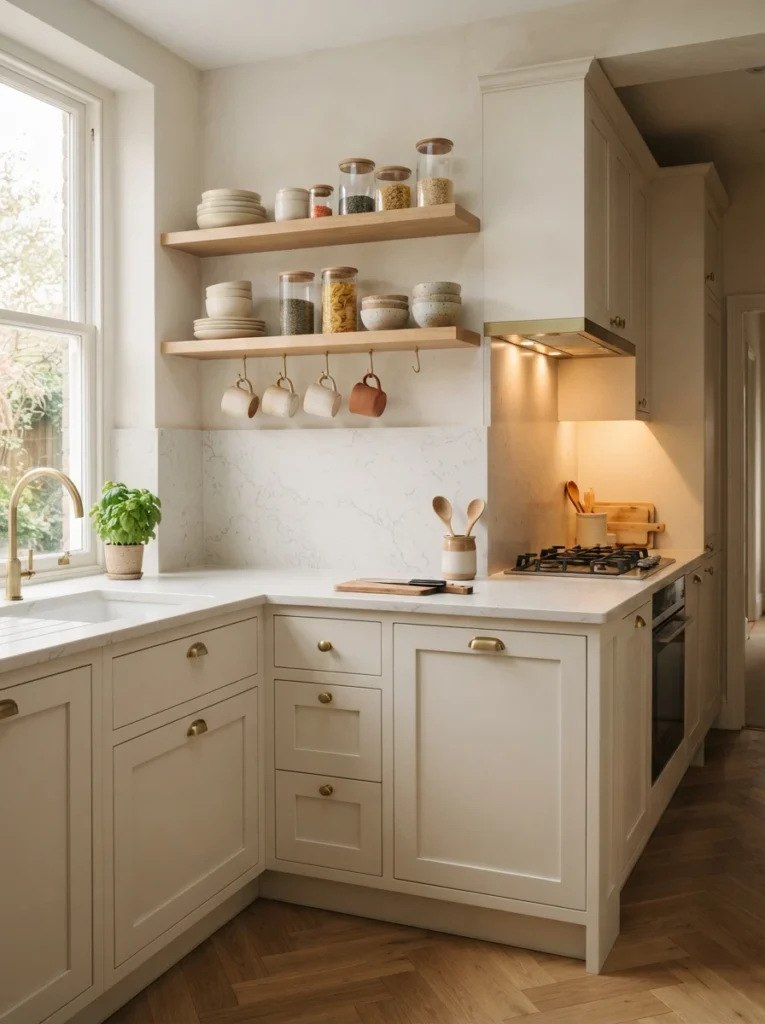
One of the biggest advantages of wall shelving is the countertop space it can free up.
Look at the objects currently sitting on your counters. Coffee mugs, jars, small bowls, spices, cooking oils, and frequently used dishes are all potential candidates for shelf storage.
Rather than covering an entire wall with shelving, start with one or two shelves above an appropriate section of countertop.
Keep frequently used items on the lower shelf and decorative or less-used pieces higher up.
A simple arrangement might include:
- Everyday mugs on the bottom shelf
- Bowls and small plates in the middle
- Attractive jars or serving pieces at the top
Leaving some empty space around objects is important. Open shelves look much calmer when every inch isn’t filled.
Practical tip: Before installing a shelf, outline its proposed position with painter’s tape. This gives you a quick sense of its size and whether it will interfere with normal kitchen tasks.
2. Display Dishes and Cups Without Creating Clutter

Everyday dishes are some of the best items to store on open kitchen shelves because they’re used frequently enough that dust is less likely to sit undisturbed for long periods.
Try grouping similar items rather than arranging everything individually.
For example, stack dinner plates together, place bowls beside them, and keep mugs in a small row.
A simple color palette can make even inexpensive dinnerware look more intentional. White, cream, pale gray, muted green, and earthy stoneware are particularly easy to coordinate with different kitchen styles.
If your dishes are colorful, allow them to become the decorative feature instead of adding many unrelated accessories.
Ask yourself: Would you still want this item on the shelf if it weren’t decorative? In a very small kitchen, useful objects should usually earn the best storage positions.
3. Organize Utensils for a Calmer Cooking Area

Utensils don’t necessarily have to occupy a drawer.
Frequently used wooden spoons, spatulas, whisks, and tongs can be placed in an attractive ceramic or metal container on a sturdy shelf near the preparation area.
You could also install a rail or hooks beneath a shelf for lighter utensils.
Keep only everyday tools visible. Rarely used gadgets are usually better inside a drawer or cabinet because too many hanging objects can make a small wall feel busy.
The goal isn’t simply to move clutter from the counter to the wall. It is to create a storage system that makes cooking easier.
4. Use Hanging Storage for Pots and Pans

Pots and pans consume a surprising amount of cabinet space.
A strong wall-mounted rail or properly designed hanging system can make better use of vertical space while keeping frequently used cookware accessible.
This approach works particularly well for attractive stainless steel, copper, carbon steel, or cast-iron cookware.
However, weight matters.
Heavy cookware requires appropriate hardware, suitable wall construction, and secure installation. Don’t assume a decorative shelf or lightweight hook can support a heavy pan.
Position hanging cookware where you can reach it comfortably without creating a head-height obstacle or blocking a walkway.
5. Combine Open Shelving With Cookware Storage
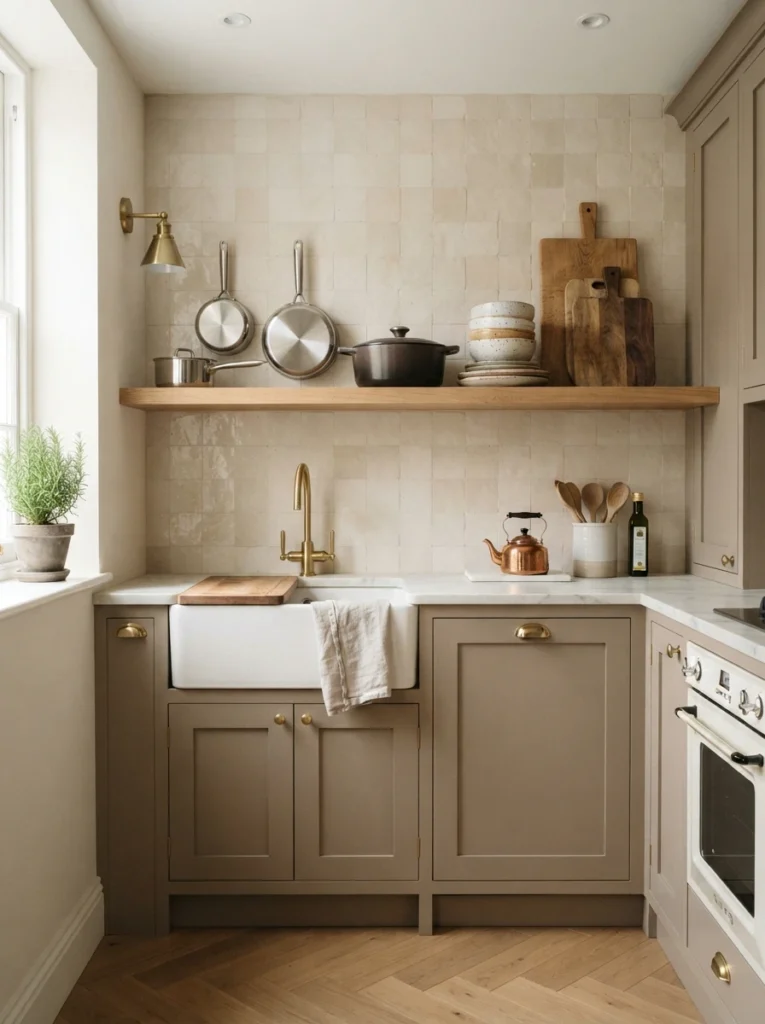
If hanging every pan feels too visually busy, open shelves offer another option.
Place larger cookware on a sturdy lower shelf while keeping smaller pieces above. Matching or similarly colored cookware can create a particularly cohesive display.
You can also mix cookware with practical kitchen objects.
For example:
Small saucepan + wooden cutting board + ceramic bowl + everyday plates
This combination provides useful storage while preventing the shelf from looking like an equipment rack.
Check the shelf’s load rating and installation requirements before storing heavy cookware.
6. Work Shelving Around Wall-Mounted Lights and Appliances
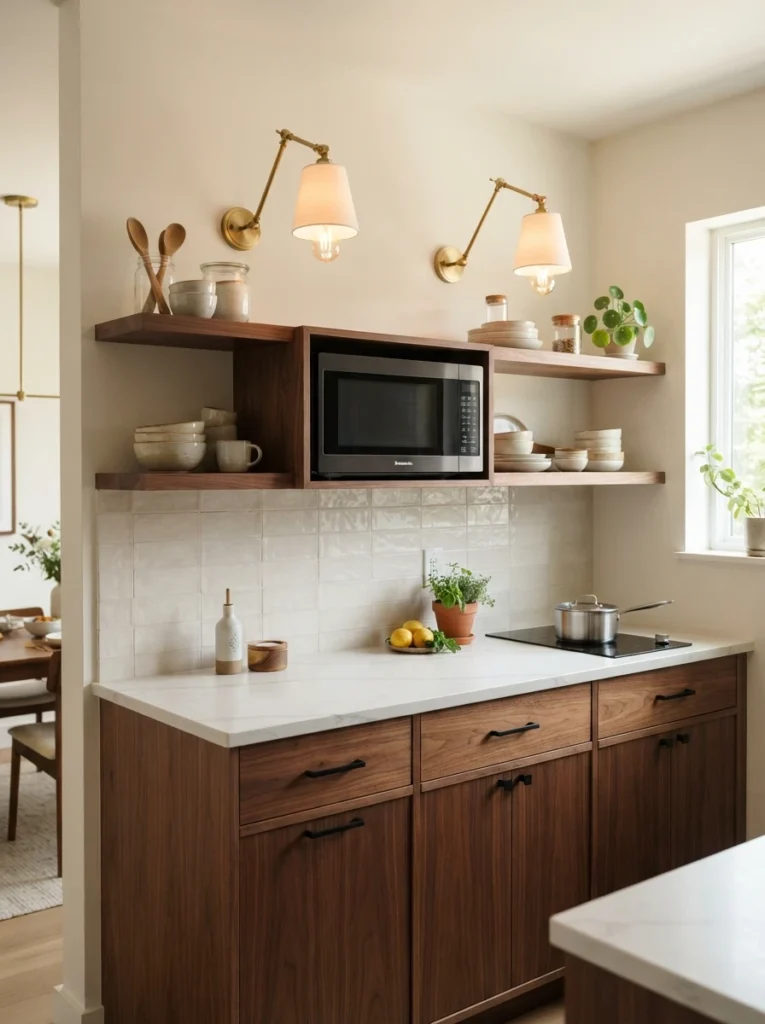
Small kitchens often require several functions to share one wall.
Lighting, appliances, cabinets, and shelving may all compete for limited space, so planning becomes especially important.
A wall-mounted light can illuminate a countertop while leaving the work surface free. Nearby shelving can then hold lightweight essentials.
If you’re planning shelving around a microwave, follow the appliance manufacturer’s requirements for ventilation, clearances, support, and installation. A microwave shouldn’t simply be placed on an improvised shelf because it happens to fit.
Measure first and design the shelving around safe appliance use rather than the other way around.
7. Create a Dedicated Spice Shelf
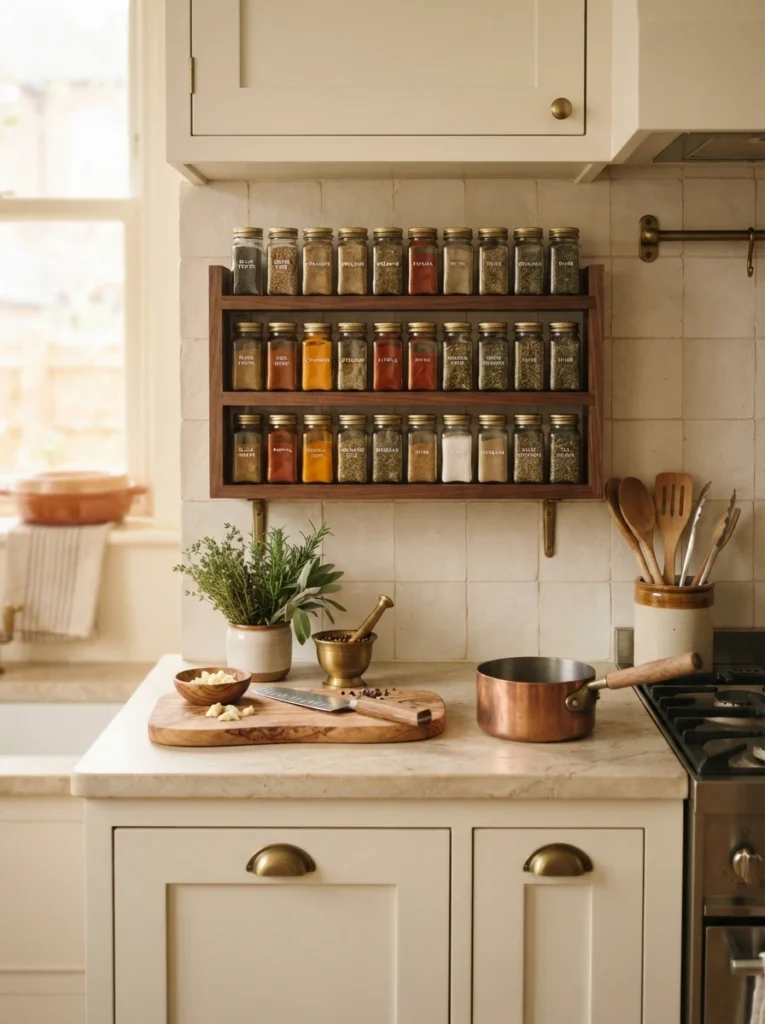
A compact spice shelf can solve one of the most frustrating small-kitchen problems: searching through a crowded cabinet while cooking.
Install a shallow shelf where labels remain easy to see.
You can organize spices:
- Alphabetically
- By cuisine
- By frequency of use
- By sweet and savory categories
Avoid placing spices where excessive heat, steam, or direct sunlight could affect their quality. A location near the food-preparation zone but away from intense heat is usually more practical.
Matching jars can create a tidy appearance, but they aren’t essential. Clear labeling and easy access matter more.
8. Store Pots and Pans on an Upper Shelf
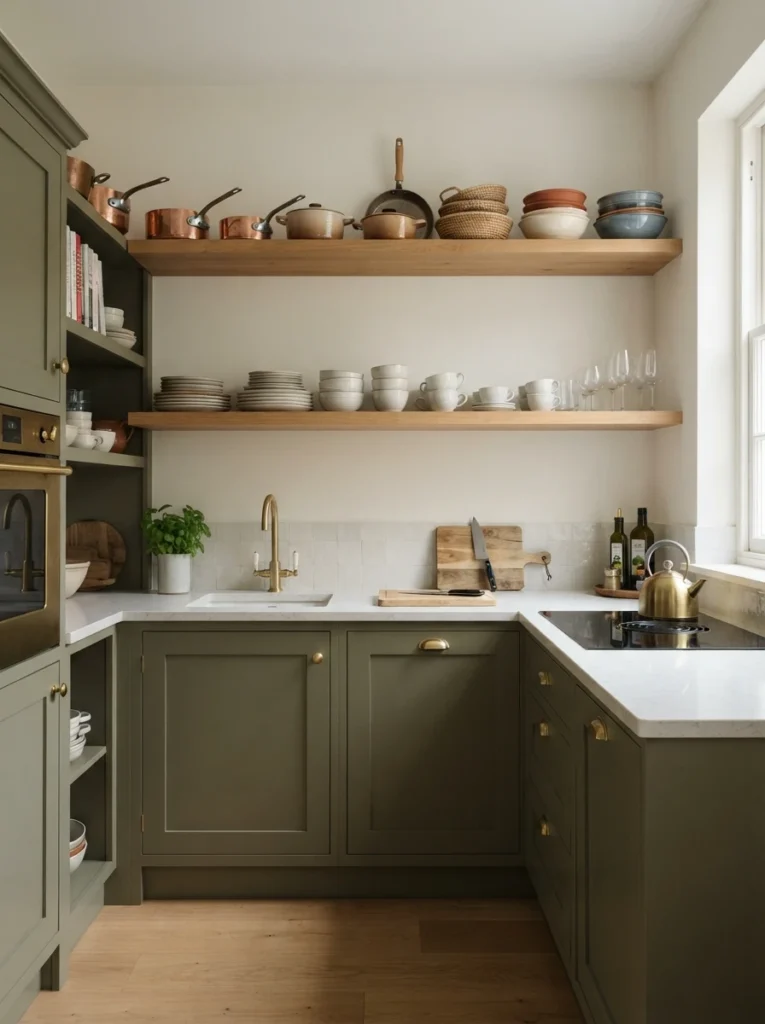
Upper wall space is often overlooked, particularly in kitchens without cabinets extending to the ceiling.
A properly installed upper shelf can accommodate cookware or serving pieces that aren’t required several times a day.
Keep accessibility in mind. Heavy pots shouldn’t be stored so high that retrieving them becomes awkward or unsafe.
A better strategy is:
Lower shelves: everyday lightweight items
Middle shelves: dishes and frequently used cookware
Upper shelves: lighter, occasional-use pieces
Storage should follow how you actually use the kitchen.
9. Create a Clean and Ready Shelf Setup
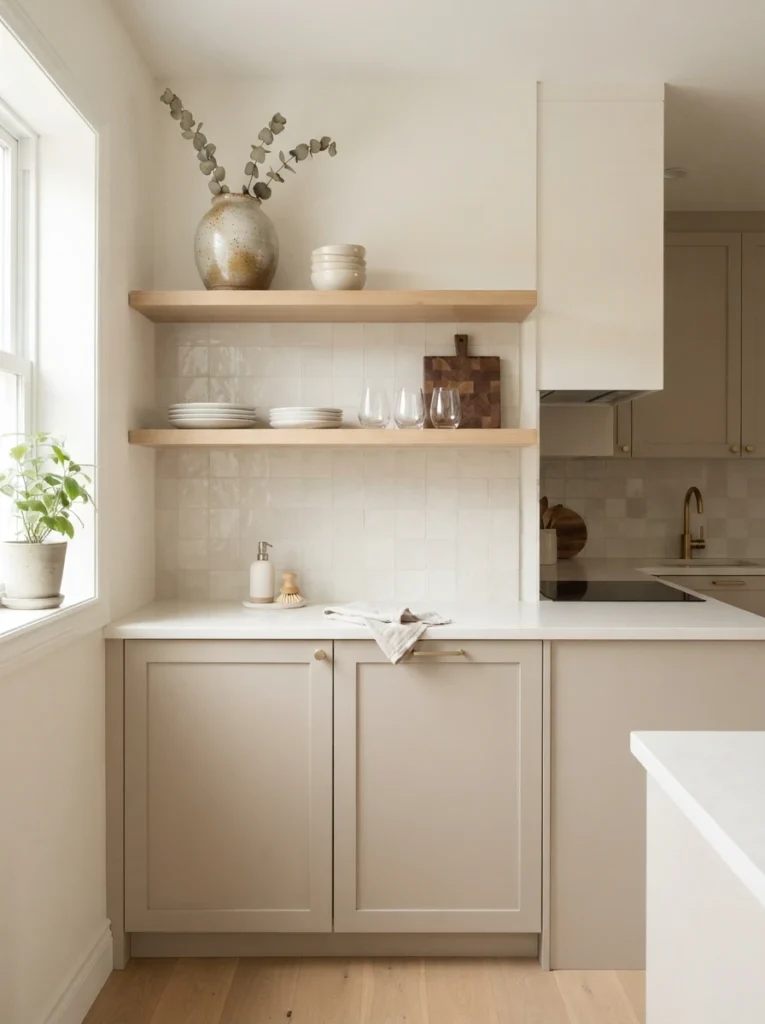
Open shelving looks best when it feels intentional rather than overfilled.
Start by removing everything from the shelf. Then return only items that are useful, attractive, or both.
Group objects according to function and scale. Large pieces can act as visual anchors, while smaller objects fill limited gaps.
Try following a simple rhythm:
Large item → grouped everyday objects → small accent → open space
That final element—open space—is easy to forget.
A shelf doesn’t need to be completely full to be useful. In fact, a little breathing room often makes a small kitchen appear more spacious.
10. Pair Cheerful Yellow Walls With Simple Shelves

Shelving doesn’t have to be neutral.
Against yellow walls, simple wood or white shelves can create a cheerful kitchen with plenty of personality.
Warm yellow works beautifully with natural wood, white ceramics, woven accessories, and small amounts of greenery.
If the wall color is already strong, keep the shelf styling relatively restrained. Too many colorful objects competing against a bright background can make a compact kitchen feel visually crowded.
Let either the wall or the objects provide the main color statement.
11. Make Green Shelves a Feature
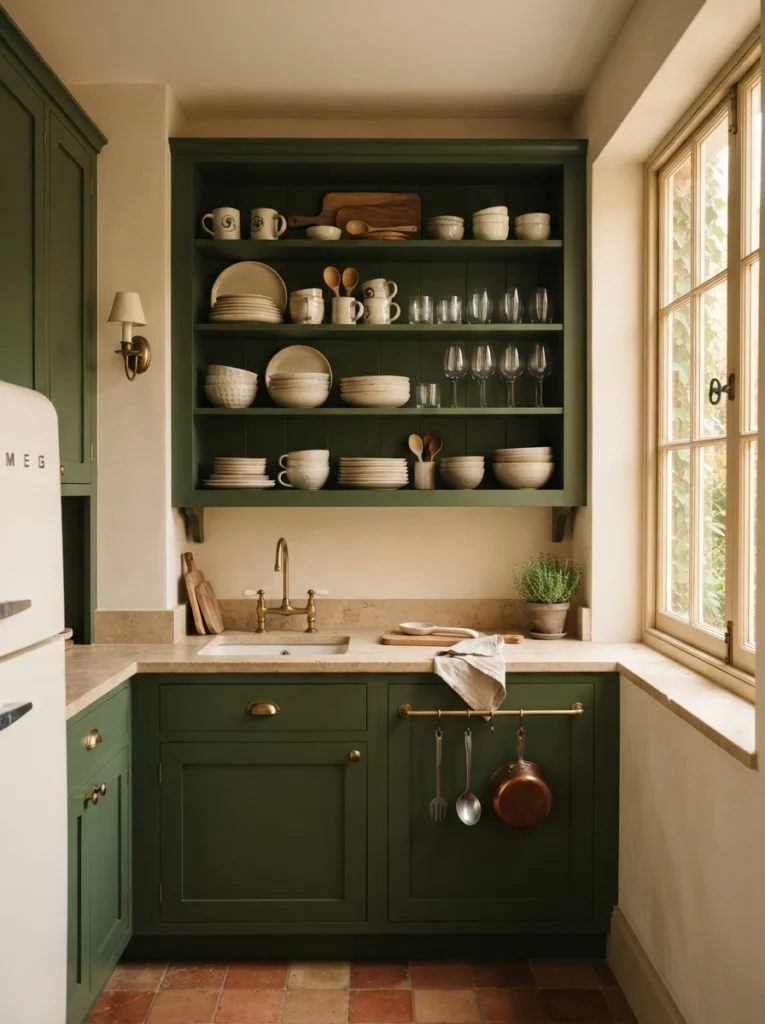
Green shelving can bring an unexpected furniture-like quality to an ordinary kitchen wall.
Muted sage works well in relaxed traditional kitchens, while olive and forest tones can create a richer appearance.
Style green shelves with cream dishes, clear glasses, wooden pieces, and neutral mugs to balance the stronger color.
If you’re painting existing shelves, choose a finish appropriate for the material and conditions in your kitchen.
A small section of colored shelving can make a bigger impact than painting every available surface.
12. Stack White Dishes for a Clean, Cohesive Look

White dinnerware is particularly effective on open shelves because different pieces can still look coordinated.
Instead of making one tall stack, divide dishes into manageable groups.
For example:
- Dinner plates
- Side plates
- Shallow bowls
- Deep bowls
- Cups
The repetition of white creates visual continuity, while the different shapes keep the arrangement interesting.
Natural wood shelving adds warmth, whereas white shelves create a more seamless appearance against pale walls.
13. Create an Appliance Shelf to Free the Counter

A toaster, blender, mixer, coffee machine, and other small appliances can consume most of a compact countertop.
Moving an appropriate appliance to dedicated shelving may help, but usability and safety should determine what goes there.
Consider:
- Appliance weight
- Shelf load capacity
- Electrical access
- Cord position
- Ventilation requirements
- Heat produced during operation
- Manufacturer’s placement instructions
Some appliances are better stored on a shelf and moved to the counter before use, while others may require a permanent work surface.
Don’t sacrifice safe operation just to achieve an uncluttered photograph-worthy kitchen.
14. Combine Dishes and Utensils on Upper Shelving
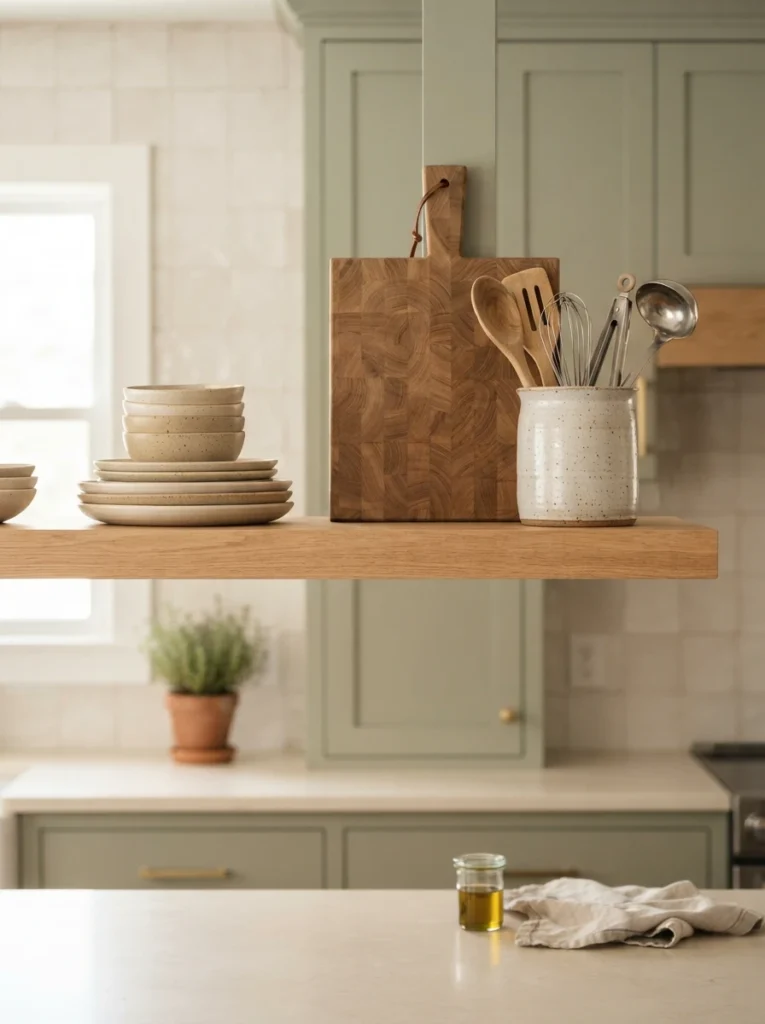
Mixed storage can work beautifully when objects are grouped according to purpose.
Try placing stacked dishes on one side and a container of frequently used utensils on the other. Add a cutting board or small serving piece between them to create visual separation.
The result should feel practical rather than staged.
Keep heavier everyday items within comfortable reach and reserve higher areas for lighter objects.
15. Bring Life to Shelves With Plants and Cookware
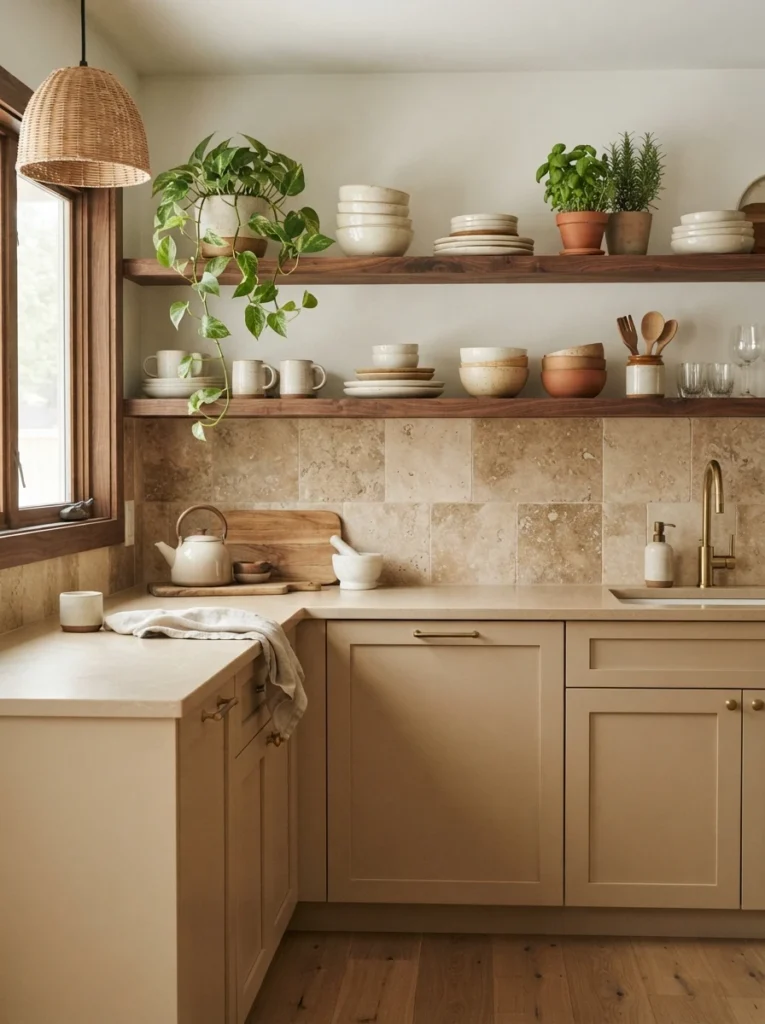
A little greenery can soften a wall filled with hard kitchen materials.
A compact trailing plant, small herb pot, or simple leafy plant can sit alongside dishes and cookware.
Kitchen herbs can be especially useful if conditions are appropriate.
However, choose plants according to the actual light and humidity in the space. Don’t place a plant on a shelf simply because the spot looks attractive.
Also consider watering. Plants shouldn’t be positioned where drainage could damage wood shelving, electrical appliances, or food below.
One or two plants are usually enough for a small kitchen.
16. Install Wooden Shelves Above the Sink
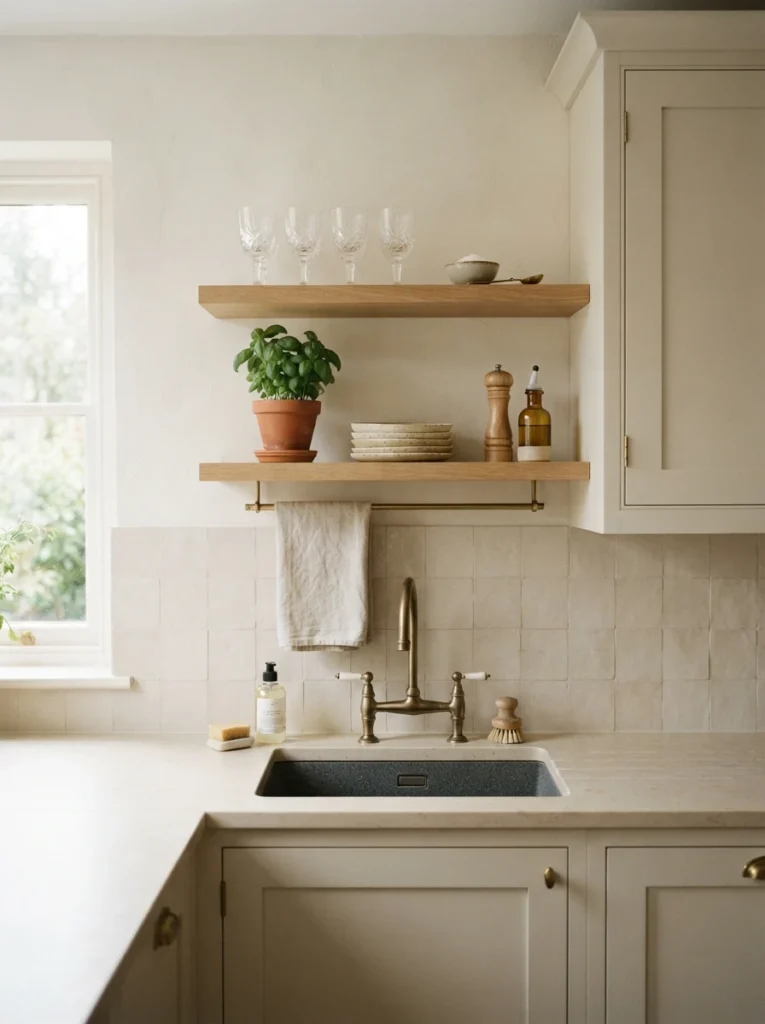
The wall above a sink can provide valuable storage, especially when there isn’t a window occupying the area.
A slim wooden shelf could hold lightweight everyday dishes, small plants, glasses, or frequently used kitchen essentials.
Because the sink produces splashes and humidity, choose materials and finishes suitable for that environment.
Shelf depth also matters.
An excessively deep shelf can make washing dishes uncomfortable or create a surface you’re likely to bump into. Mock up the depth before installation to see how it feels while standing at the sink.
17. Blend White Wall Shelves Into the Background

When you want extra storage without making a compact kitchen look smaller, shelves painted to match the wall can be effective.
White-on-white shelving visually recedes rather than becoming the room’s dominant feature.
You can then introduce subtle contrast through:
- Wooden cutting boards
- Clear glass jars
- Neutral ceramics
- Stainless steel
- Small green plants
- Woven baskets
This strategy works particularly well in narrow kitchens where heavy-looking storage could overwhelm the room.
18. Arrange Mixed Kitchen Essentials With Purpose
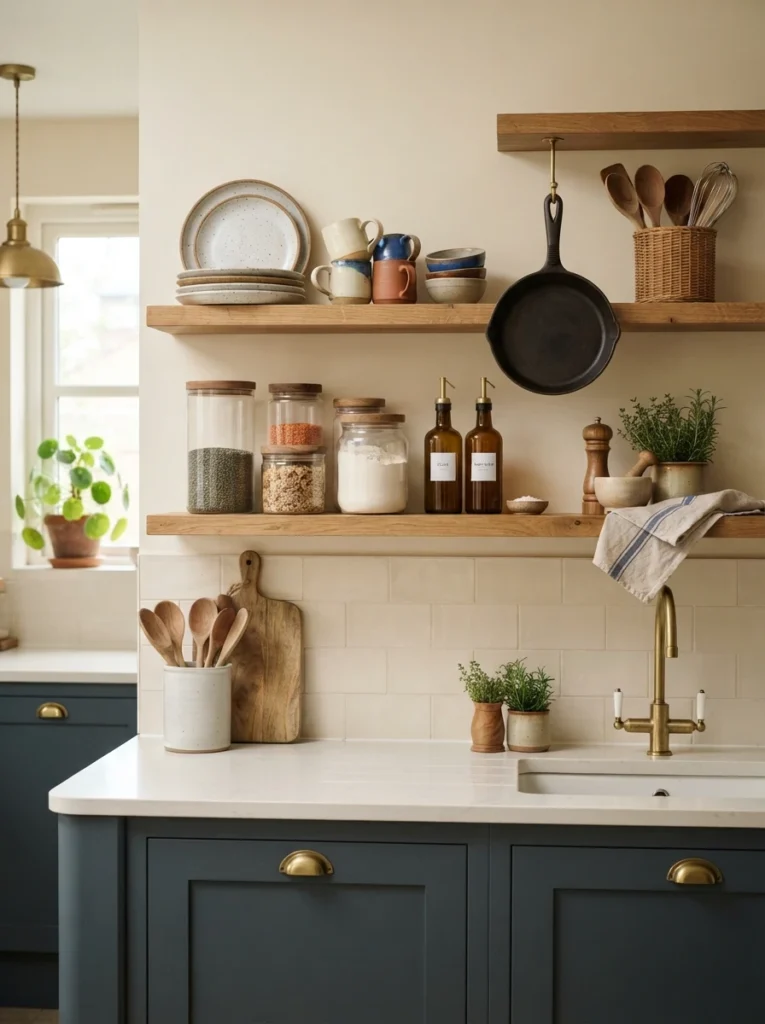
Real kitchens rarely contain perfectly matching objects.
Your shelves may need to hold mugs, bowls, jars, bottles, plates, cookware, and food containers all at once.
The solution isn’t necessarily buying matching replacements.
Instead, organize visually.
Keep similar objects together, place taller pieces toward the ends or back, and use trays or baskets to contain small loose items.
Repeated materials can also create cohesion. Several wooden objects or a few pieces of similar ceramic can visually connect otherwise different items.
19. Build Simple DIY Wooden Plank Shelves
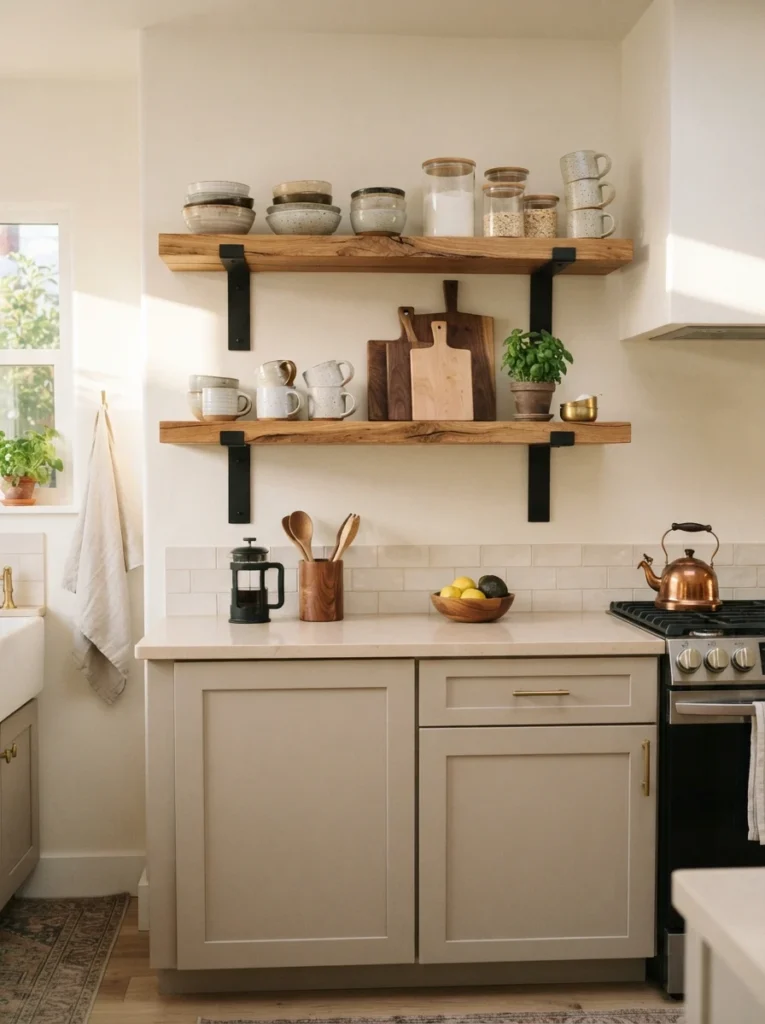
A basic wooden shelf can be an affordable way to add storage to an empty wall.
Before starting, decide exactly what the shelf needs to hold. That determines the appropriate depth, material, brackets, and installation method.
A typical project involves:
- Measuring the available wall space.
- Determining an appropriate shelf depth.
- Selecting suitable wood and brackets.
- Sanding the wood thoroughly.
- Applying an appropriate protective finish.
- Locating suitable fixing points.
- Installing brackets level and securely.
- Testing the shelf before loading it.
If you’re unsure about wall construction, wiring, plumbing, fasteners, or load requirements, consult someone qualified rather than guessing.
A beautiful shelf isn’t useful if it isn’t safely installed.
20. Display Cups and Mugs Above the Counter

Mugs are ideal candidates for compact open storage.
Place frequently used mugs on a shelf above a coffee or tea preparation area to create a simple beverage station.
You can line mugs along the shelf or use suitable under-shelf hooks if the system is designed for them.
Keep the arrangement manageable.
Six frequently used mugs usually make more sense than displaying an entire collection of twenty in a tiny kitchen.
Store occasional or sentimental cups elsewhere and reserve prime shelf space for everyday items.
21. Consider a Shelf Near the Stove Carefully

The wall around a stove may look like unused storage space, but it requires more consideration than most kitchen areas.
Heat, grease, steam, and required clearances can make certain shelf placements unsuitable.
Rather than automatically installing shelving directly over a cooktop, check the requirements for your stove, range hood, backsplash, and surrounding materials.
Where appropriate and permitted, nearby shelving can hold items used during cooking—but keep objects that could be damaged by heat or contaminated by grease away from problematic areas.
Safety and easy cleaning should come before gaining a few extra inches of storage.
22. Use Natural Light to Keep Open Shelves Feeling Airy
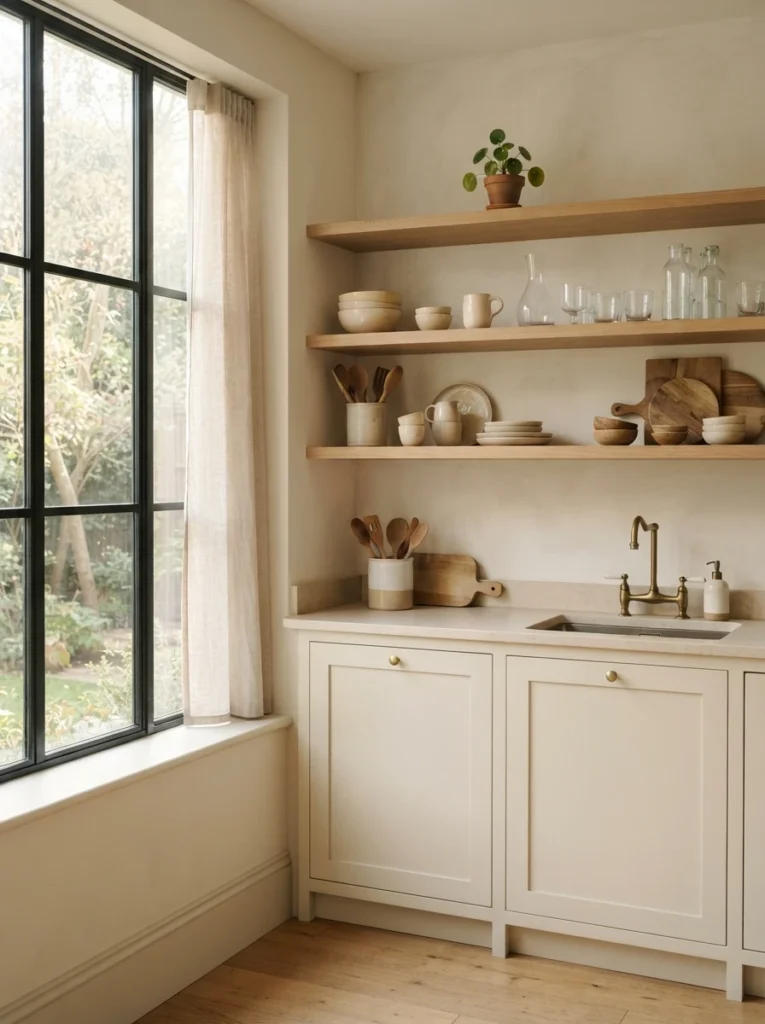
Good lighting can make compact shelving feel lighter and more attractive.
If your kitchen receives natural light, avoid unnecessarily blocking windows with bulky shelving.
Instead, place shelves beside a window or on a nearby wall where daylight can illuminate the objects without sacrificing the window opening.
Glassware and pale ceramics work especially well in naturally lit spaces because they reflect light.
However, consider what you store in strong direct sun. Certain foods, spices, oils, and materials are better kept away from prolonged light or heat.
23. Build a Small-Kitchen Shelf System That Works Every Day

The most effective shelving arrangement isn’t necessarily the prettiest one. It is the one that reduces unnecessary movement while you’re cooking, cleaning, and serving food.
Think of the kitchen in activity zones.
Preparation Zone
Keep cutting boards, mixing bowls, frequently used ingredients, and preparation tools nearby.
Cooking Zone
Store appropriate cooking utensils and commonly used cookware within convenient reach while respecting heat and safety requirements.
Washing Zone
Keep dishwashing essentials and frequently used dishes close to the sink or dishwasher when practical.
Coffee or Breakfast Zone
Group mugs, coffee supplies, tea, and breakfast essentials together.
Once shelves correspond to these activities, a small kitchen can feel considerably more organized.
Before installing anything permanent, spend a few days noticing your movements. Where do you repeatedly walk across the kitchen to retrieve something?
That is often where smarter storage can make the biggest difference.
Smart Small Kitchen Shelf Planning Guide
Before choosing a shelf, consider both its appearance and intended function.
| Shelf Location | Good For | Main Consideration |
|---|---|---|
| Above counter | Mugs, bowls, jars | Comfortable reach |
| Near prep area | Utensils, dishes | Keep workspace clear |
| Near sink | Lightweight dishes, glasses | Moisture and splashes |
| Upper wall | Occasional-use items | Accessibility |
| Coffee station | Mugs, tea, coffee supplies | Convenient grouping |
| Near cooking zone | Appropriate cooking essentials | Heat and grease |
| Bright wall | Dishes, glassware, décor | Direct sunlight |
Measure carefully rather than choosing shelf dimensions based solely on appearance.
Frequently Asked Questions
Are open shelves a good idea in a small kitchen?
They can be. Open shelves use vertical wall space and can make frequently used items easier to reach. However, they work best when carefully organized rather than overloaded.
How do I make small kitchen shelves look less cluttered?
Group similar objects, limit decorative accessories, repeat a few colors or materials, and leave some empty space between groups.
What should I put on open kitchen shelves?
Frequently used dishes, mugs, bowls, glassware, appropriate cookware, jars, cutting boards, and a small amount of décor are practical options.
How deep should small kitchen shelves be?
There isn’t one ideal depth for every kitchen. The correct size depends on what you plan to store, available wall space, surrounding cabinets and appliances, and comfortable movement. Measure your largest intended items before selecting shelf dimensions.
Can I put heavy pots on floating shelves?
Only when the complete shelf system, wall structure, anchors, and installation are designed to support the intended load. Check the manufacturer’s specifications and use appropriate installation methods.
How can I make open shelves easier to maintain?
Store frequently used objects on them, avoid excessive decorative clutter, and choose surfaces that can be wiped easily. Items used regularly naturally get cleaned more often than purely decorative pieces.
Conclusion
The best smart small kitchen shelf ideas aren’t simply about fitting more things onto the walls. Good shelving should give your kitchen more usable workspace, make everyday essentials easier to reach, and create an organized appearance without adding visual clutter.
Start by identifying the problem you actually need to solve. Maybe mugs are taking over the counter, cookware is consuming an entire cabinet, or spices are difficult to find. Solve that one problem first rather than covering every empty wall with shelves.
Then organize storage according to how you cook and move through the room. Keep everyday essentials within comfortable reach, place occasional pieces higher, leave some visual breathing room, and always consider weight, heat, moisture, and appliance requirements before installation.
Even one thoughtfully positioned shelf can make a compact kitchen easier to use—and that’s far more valuable than simply adding more storage.